Putting Down the Camera: What Happens When You Stop Performing Your Trip and Start Living It
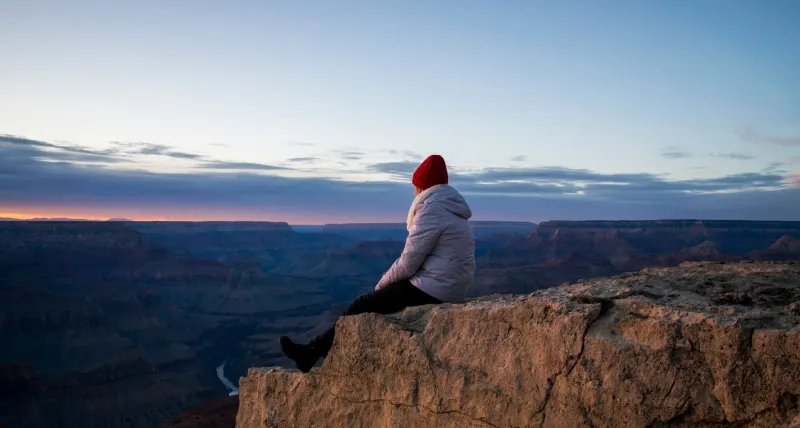
There's a moment I keep coming back to. I was standing at the rim of the Grand Canyon at sunrise—actual sunrise, the kind that makes grown adults go quiet—and the guy next to me was watching the whole thing through a four-inch screen, angling his phone to get his face and the canyon in the same shot. He must have taken forty pictures in the time the light shifted from pink to gold. Then he left.
I'm not judging him. I've been that guy. More times than I'd like to admit.
Somewhere along the way, travel stopped being something we do and became something we show. And if you've ever caught yourself composing a caption before you've even processed where you are, you already know what I mean.
The Invisible Audience We're Always Performing For
Here's the weird part: most of us aren't even famous. We're not travel influencers with sponsorships and follower counts that justify the hustle. We're regular people on a road trip through the Southwest or a long weekend in New Orleans, and yet we're curating, filtering, and narrating our experiences in real time like someone's watching.
Someone is watching, technically. But they're also half-watching a cooking reel and a video of someone's dog, and they'll scroll past your perfectly lit photo of Bourbon Street in about 0.8 seconds.
The invisible audience isn't really them. It's some imagined version of yourself—the traveler you want to be seen as. The one who's adventurous and cultured and effortlessly cool. And chasing that image costs something real: the actual experience happening right in front of you.
Psychologists call this "self-presentation behavior," and studies have found that when people focus on documenting an experience for others, their own memory of that experience actually gets fuzzier. You end up with a hard drive full of photos and a surprisingly hollow recollection of what it felt like to be there.
The Gap Between the Story and the Moment
Travel stories we share online tend to be one of two flavors: triumphant or charmingly chaotic. Either the hike was breathtaking and transformative, or the hostel was a disaster and you laugh about it now. Both make good content. Both are also incomplete.
The truth of travel lives in the in-between—the hours that don't make the highlight reel. The long bus ride where you stared out the window thinking about nothing in particular. The meal that was just okay. The afternoon where you sat on a park bench in a city you didn't know and felt genuinely, quietly happy for no specific reason.
Those moments don't perform well. They don't get saves or shares. But they're often the ones that actually change you.
I talked to a woman once who'd done a solo trip through the Pacific Northwest—Oregon coast, Crater Lake, up into Washington. She said the part she remembered most wasn't the dramatic overlooks or the famous spots. It was a rainy afternoon in Astoria where she found a used bookstore, bought two novels, and sat in a coffee shop for three hours reading. No photos. No story to tell. Just time that was entirely hers.
"I didn't post anything that day," she told me. "And it was the best day of the whole trip."
Why We Do It Anyway
It would be easy to blame social media as if it's some external force we're all helpless against. But that's too convenient. The pressure to document is also about fear—fear that if we don't capture it, it didn't count. That we won't remember. That no one will believe we were really there.
There's also a loneliness to travel that nobody talks about enough. Sharing photos is a way of reaching out, of saying I'm here, look at this, isn't it something? When you're far from home, that impulse to connect is real and human and not something to be ashamed of.
The problem isn't sharing. It's when sharing becomes the point—when you're engineering the experience around the content instead of letting the content come from the experience.
Practical Ways to Reclaim the Moment
None of this requires you to delete Instagram or leave your phone at home. Small shifts in habit can make a significant difference in how fully you actually inhabit a place.
Try the "five minutes first" rule. When you arrive somewhere worth photographing, put the phone away for five minutes. Look. Feel. Let the place land before you start composing a shot. You'll take better photos anyway—and you'll actually remember being there.
Designate documentation time. Give yourself a window—say, thirty minutes after lunch—to post, caption, and engage. Outside that window, the phone stays in your pocket. Structure takes the guilt out of it. You're not ignoring your audience; you're just making them wait.
Keep a private journal instead of a public one. Writing for yourself, with no audience in mind, forces honesty. You can admit the thing was overrated, or that you cried in the parking lot of a national park for reasons you're still figuring out. That's where the real travel writing lives.
Ask yourself: am I doing this, or am I filming myself doing this? It's a subtle but important distinction. One is experience. The other is content production.
What You Get Back
The first time I deliberately left my phone in the hotel for a full afternoon—in Savannah, Georgia, wandering the squares with nothing but my eyes and a vague sense of direction—I felt almost anxious at first. Then something loosened. I noticed more. A cat on a wrought iron fence. The smell of magnolia. Two old men playing chess in the shade.
None of it was Instagrammable. All of it was real.
Travel at its best isn't a series of content moments. It's a slow accumulation of presence—the particular way light hits a street you'll never walk again, the taste of something you can't quite describe, the feeling of being genuinely, temporarily unmoored from your regular life.
You can't capture that. But you can live it.
And maybe that's the whole point.